Work
Our Insights
Inspired by our day-by-day work, we always look for innovative approach leveraging new technologies to solve complicated transportation problem.
Read our 2025 TRB paper on adaptive ramp metering performance evaluation, partnered with California Department of Transportation (Caltrans) and Metropolitan Transportation Commission (MTC).
In addition to I-880, we are currently supporting MTC and Caltrans to implement ARM on several other corridors in the Bay Area including US-101 and SR-237.
Evaluation of an Adaptive Ramp Metering System in San Francisco Bay Area



Abstract
Simulation-based ramp metering evaluation studies have been conducted and have offered helpful insights. However, very few field assessments have been performed in the past to evaluate adaptive ramp metering (ARM) systems. There is a gap in understanding the actual benefits of an ARM system based on real data, not simulated data.
This paper presents an evaluation of the ARM system deployed on Interstate 880 (I-880) in the San Francisco Bay Area, a 45-mile corridor with 136 on-ramps in both directions. The “on/off” approach, which involves turning off ARM for a brief period to gather data for the “without” condition and then turning it back on again, provides a more objective evaluation since it minimizes the influence from external factors such as post-pandemic recovery and seasonal variations. Unlike simulation-based evaluations, this study was performed for a recent field deployment of an ARM system based on Big Data, including INRIX and detector data.
The ARM system deployed on I-880 has demonstrated notable improvements based on the performance measures used in this study. It was found that on mid-weekdays, ARM reduced travel time by 4%, increased speed by 3%, reduced delay by 16%, decreased vehicle hours of delay (VHD) by 16%, and reduced bottleneck congestion levels by 18%.
This study provides valuable insights into potential benefits of adaptive ramp metering systems within urban freeway environments.
Study Corridor
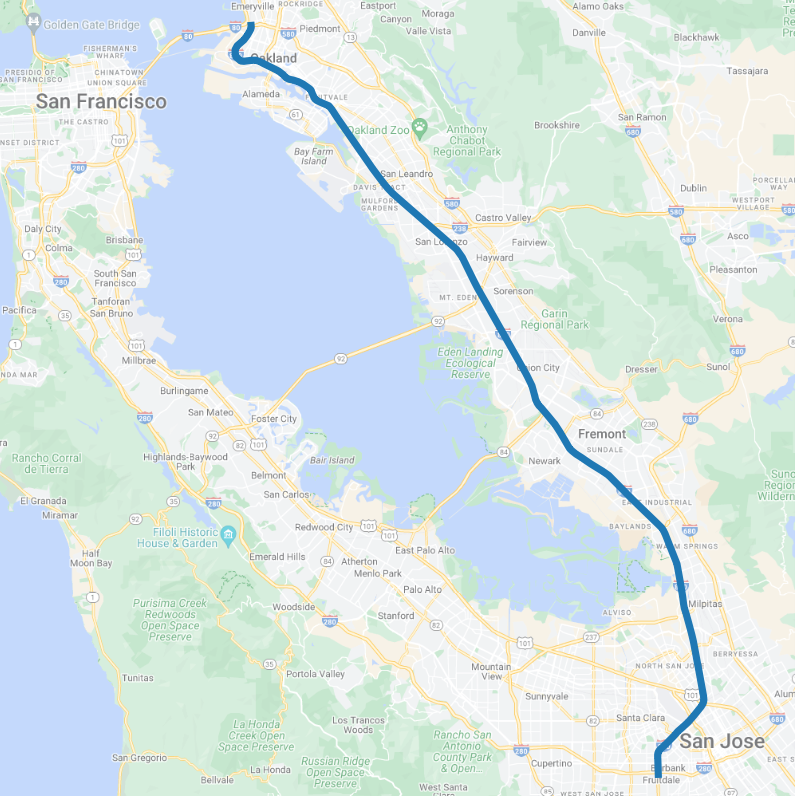
The Interstate 880 (I-880) Corridor, stretching between the I-280 Interchange in Santa Clara County and the West Grand Ave on-ramp in Alameda County, serves as the primary north-south freeway route in the San Francisco Bay Area.
Traditional local responsive ramp metering was implemented on the I-880 corridor. Since May 2022, Adaptive Ramp Metering (ARM) has been progressively implemented on this corridor in five phases, with the final phase completed in September 2022.he Interstate 880 (I-880) Corridor, stretching between the I-280 Interchange in Santa Clara County and the West Grand Ave on-ramp in Alameda County, serves as the primary north-south freeway route in the San Francisco Bay Area.
Methodology
The “on/off” approach (or “with/without analysis”) was selected for this project. An on/off approach involves turning off ARM for a brief period to gather data for the “without” condition, and then turning it back on again. The on/off approach provides a more objective evaluation since it minimizes the influence from external factors such as post-pandemic recovery and seasonal variations.
Unlike a traditional before/after analysis, the on/off approach enables the collection of comparative data just weeks apart, compared to the “before” and “after” data which are typically months or years apart.
- ARM On: March 20 – April 14, 2023
- ARM Off: April 17 – 30, 2023
- ARM On: May 1 – 26, 2023
Conclusions
This paper contributes to the understanding of adaptive ramp metering systems’ effectiveness in urban freeway settings, using I-880 as a case study. Through comprehensive data analysis and performance evaluation, the study highlights the benefits of adaptive ramp metering in improving freeway operations.
▪ Travel Time and Speed: Overall, average travel time decreased by 4% and average speed increased by 3%.
▪ Delay: Average delay decreased by 16%.
▪ VHD: Average VHD decreased by 16%.
▪ Overall congestion levels were reduced by 26% in March/April, and 9% in May.
Although the “on/off” approach used in this study provides a more objective evaluation since it minimizes the influence from external factors such as post-pandemic recovery and seasonal variations, it is important to understand that there are other confounding factors. Other than ARM, other factors such as changes of traffic volumes and congestion on the nearby corridors can also influence traffic conditions on I-880.
In conclusion, the adaptive ramp metering system deployed on I-880 has demonstrated notable improvements in the performance measures used in this study, including travel time, speed, delay, congestion level, and VHD. This study provides valuable insights into the potential benefits of adaptive ramp metering systems within urban freeway environments.