
Metropolitan Transportation Commission (MTC)
State Route (SR) 37 Traffic Congestion Relief Project
Project
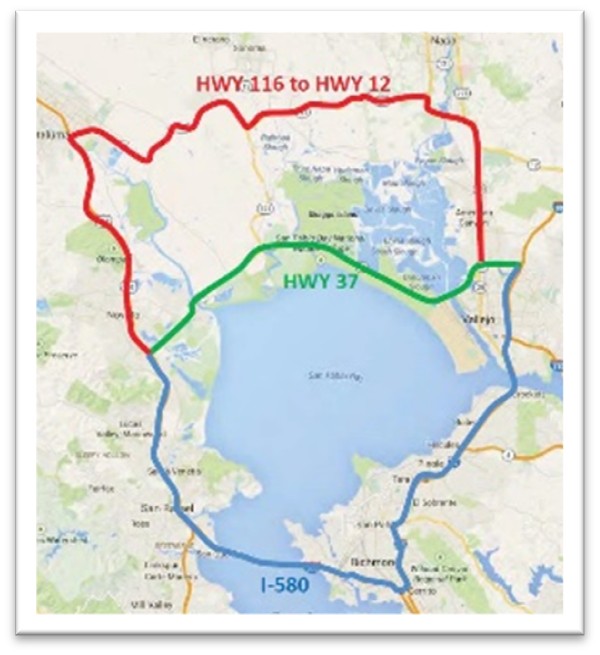
SR 37 runs along the northern shore of San Pablo Bay, linking US 101 in Novato with Interstate 80 in Vallejo. This 21-mile corridor serves as a vital connection between Marin, Sonoma, Solano and Contra Costa and the Central Valley. The low-lying corridor experiences a number of challenges, including chronic traffic congestion , vulnerability to flooding, and potential impacts on highly sensitive wetlands.
Our Work
ETG provided travel demand modeling support for Metropolitan Transportation Commission (MTC) in completing the Project Approval and Environmental Document (PA&ED), and Plans, Specifications and Estimates (PS&E) for the State Route 37 (SR 37) Interim/Traffic Congestion Relief Project.
Using MTC’s activity-based Travel Model One model, ETG developed future-year forecasts for the corridor and key study intersections on SR 37 for both the Opening Year and Design Year. The project alternatives analyzed included a contra-flow HOV lane with a moveable median barrier, as well as part-time and full-time shoulder-running HOV lanes.
To evaluate tolling strategies, ETG conducted additional mode and route shift analyses for three toll scenarios: westbound-only tolling at rates comparable to other bridges, eastbound-only tolling at similar rates, and tolling in both directions at half the standard price.
ETG also completed the SB 743 VMT analysis in accordance with the latest Caltrans Transportation Analysis Framework (TAF) guidelines for State Highway System projects. The VMT analysis—which assessed alternatives incorporating various tolling options—was among the first corridor-level VMT evaluations approved in California.